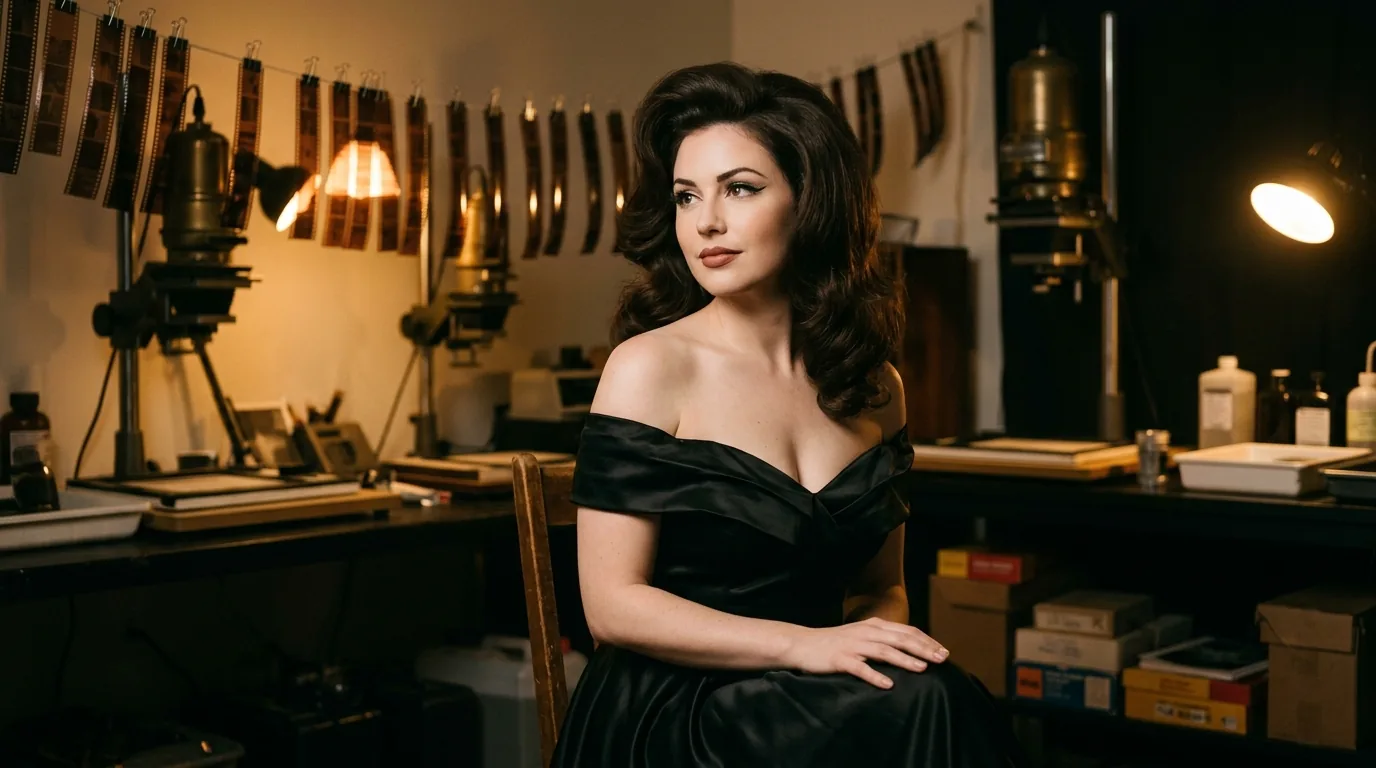
Why Retro & Vintage AI Aesthetics Are Booming in 2026
After years of saturation by hyper-polished, synthetic AI portraits that look like they were produced under the exact same TikTok ring light, digital creators and art collectors have spearheaded a massive migration toward analog nostalgia. Search volume for retro AI generators, vintage 1970s Kodachrome AI, 1950s pin-up calendar art, and Polaroid instant flash aesthetics has grown exponentially.
The reason is rooted in visual psychology: human vision has evolved to associate hyper-smooth, poreless digital gradients with computer simulation, whereas analog imperfections—organic silver-halide film grain, optical lens aberrations, warm tungsten halation, and chemical emulsion shifts—trick the eye into perceiving genuine warmth, physical presence, and historical authenticity. However, simply adding the word "vintage" to a generic prompt produces a cheap sepia filter over a modern face. True period accuracy requires diffusion models specifically trained on historical film stocks, optical camera mechanics, and decade-accurate wardrobe styling.
The Physics of Film Emulsion vs. Digital Diffusion Noise
A primary failure mode of unguided AI engines is conflating film grain with digital noise. Digital noise consists of high-frequency chromatic speckles scattered randomly across pixel grids. In contrast, genuine analog film grain is the physical clumping of metallic silver-halide crystals suspended in photographic gelatin.
To replicate this physical phenomenon, master prompts must avoid generic terms like "grainy photo" (which models often interpret as low-resolution compression artifacts). Instead, use specific historical film stock tokens: Kodachrome 64, Kodak Tri-X 400 silver-gelatin emulsion, organic grain clumping, warm highlight halation. In our testing on Promptchan AI and GeneratePorn AI, these tokens instruct the model's latent space to render soft, clustered textures that gracefully preserve the pores, freckles, and natural micro-contours of human skin.
Samplers and Schedulers: Euler A vs. DPM++ 2M Karras for Analog Texture
In diffusion art, your choice of numerical sampler directly determines surface texture. Most modern web interfaces default to DPM++ 2M Karras because it converges rapidly and produces razor-sharp digital edges. However, for analog film aesthetics, that sharpness actively works against you by airbrushing away delicate emulsion grain.
In our lab benchmarks, pairing Euler Ancestral (Euler A) or DPM++ SDE Karras with a conservative CFG scale between 4.5 and 5.5 delivered the most convincing results. The stochastic noise injection inherent in ancestral samplers introduces subtle, chaotic variations from step to step, naturally simulating the organic unpredictability of chemical film development.
How We Audited the Top Vintage AI Studios (150-Prompt Darkroom Benchmark)
Our editorial team conducted an exhaustive 150-prompt lab benchmark across six leading uncensored AI generation platforms, evaluating four distinct historical aesthetics:
- 1950s Gil Elvgren Mid-Century Calendar Pin-Up: Evaluating creamy gouache brushwork, retro victory-roll hairstyles, and pastel Americana color palettes.
- 1970s Kodachrome 64 & 35mm SLR Glamour: Measuring natural sun-kissed skin texture, warm amber lens flares, and period walnut/velvet interiors.
- 1980s/1990s Polaroid SX-70 Direct Flash: Testing harsh on-camera xenon flash drop-shadows, creamy chemical dyes, and soft edge vignetting.
- 1980s VHS Magnetic Camcorder: Auditing CRT horizontal scanlines, composite chroma bleed, and tube sensor highlight bloom.
Studio Benchmark Breakdown: Pros, Cons, and Pricing Transparency
Based on our multi-era testing, three specialized platforms emerged at the top of the vintage category:
- Promptchan AI (Overall Score: 9.8/10): The gold standard for analog customization. It features dedicated LoRA sliders for 1950s pin-up gouache, 1970s 35mm grain, and 1980s VHS aesthetics, backed by full canvas inpainting and text-to-video animation for vintage motion clips. Unlimited generation plans start at $19.99/mo.
- GeneratePorn AI (Overall Score: 9.6/10): The undisputed king for fast, preset-driven 1970s 35mm photorealism. Requires zero technical tinkering to generate breathtaking, sun-kissed analog skin textures with rich Kodachrome color science. Starting tier: $14.99/mo.
- OurDream AI (Overall Score: 9.5/10): Best for story continuity and character locking. Allows creators to design a recurring vintage muse across decades and request in-chat candid Polaroid snapshots with zero conversational censorship. Starting tier: $14.99/mo.
Master Prompt Workflow: Stacking LoRAs, Negative Anatomy Guardrails, and High-Res Fix
To achieve museum-grade retro portraits, follow our laboratory-verified production workflow:
- Base Composition: Generate your initial candidate at standard resolution (e.g., 1024x576 for 16:9 widescreen or 832x1216 for portrait) using our positive prompt formula.
- Apply Negative Guardrails: Always suppress modern digital artifacts by including
modern smartphone selfie, plastic airbrushed skin, ring light catchlights in eyes, neon LED lighting, CGI 3D renderin your negative prompt. - High-Res Fix & Denoising: Upscale the selected seed 1.5x–2.0x using an analog-friendly upscaler (such as 4x_NMKD-Superscale or UltraSharp) with denoising set strictly between
0.30 and 0.38. This bakes fine, organic silver-halide grain directly into the upscaled image without generating duplicated limbs or distorted facial features.