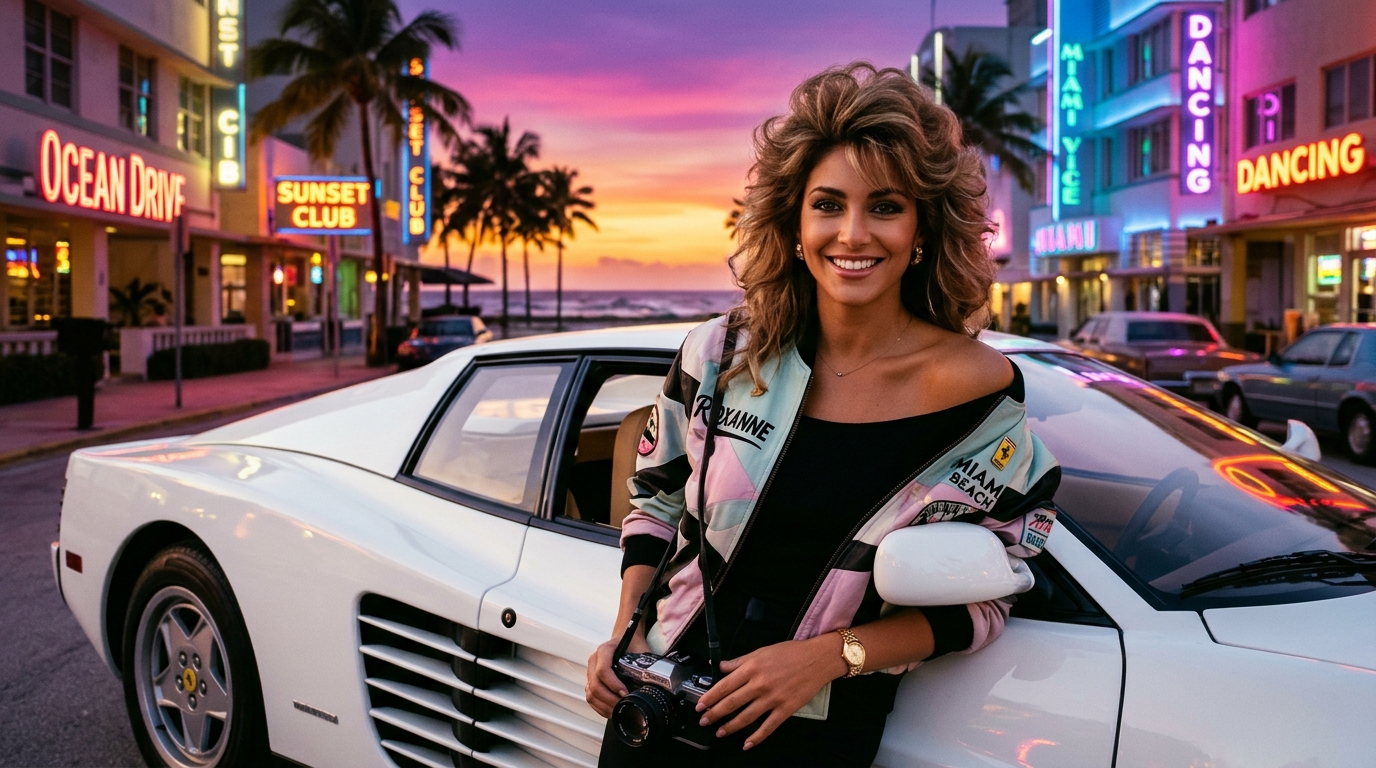
From Vice City Ocean Drive to 1986 Tokyo: Why Valerie Built Studio 80-X
Before I packed my Roland Juno-106 synthesizer, a crate of Type IV metal cassettes, and my Leica M4 into a suitcase bound for Tokyo, I grew up under the flamingo-pink neon marquees of Miami's Ocean Drive. With the entire world counting down to next month's return to Vice City and the sun-drenched streets of Leonida, search demand for authentic Vice City AI art, 1986 Miami OutRun aesthetics, and retro crime-romance companions has exploded.
Here in my rainy late-night Tokyo studio, I test every uncensored AI checkpoint to solve a problem that drives me crazy: when most people type "Vice City girl" into a standard AI generator, they get a cheap, oversaturated purple cartoon filter slapped over plastic skin. Real 1986 Miami glamour wasn't digital—it was shot on high-speed Kodak Ektachrome 400 slide film and Sony Betacam SP broadcast tape, where humid coastal air made every Art Deco neon sign bloom like liquid fire across wet asphalt and white Testarossa hoods.
Engineering the True Vice City & Leonida Sunset Palette (Ektachrome 400 vs. Cheap Neon Filters)
To capture the cinematic soul of 1980s South Florida without sacrificing photorealistic skin texture, you must separate environmental lighting from skin subsurface scattering. When you prompt generically for "synthwave lighting", diffusion models flood the subject's face with flat purple and blue paint.
Instead, anchor your prompt in physical photography mechanics: specify golden-magenta coastal twilight sky in the background, warm tungsten streetlight key light on her face, cyan and flamingo-pink Art Deco neon rim light reflecting off wet pavement. This three-point lighting formula keeps your heroine's skin warm, touchable, and naturally textured while surrounding her in unmistakable Vice City atmosphere.